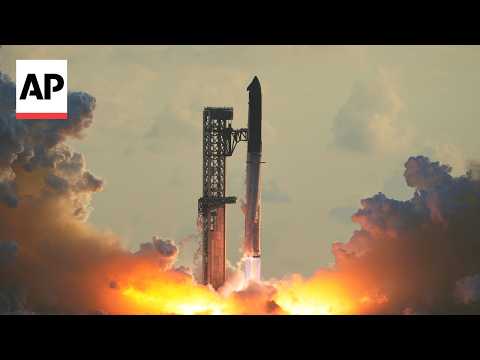
Fourteenth integrated flight of Starship and Super Heavy, and the first to put Starship into Earth orbit. Ship 41 lifted off from Starbase on Booster 21 during the window that opened at 7:15 a.m. CT. SpaceX confirmed liftoff, hot-staging, and Super Heavy splashdown in the Gulf of America. The ship performed a single-Raptor insertion burn into an orbit of about 275 km — the step prior flights had deliberately not taken, so a missed burn would still reenter. It then deployed all 26 Starlink V3 satellites. SpaceX reported contact with every satellite, and Elon Musk said they were operating nominally. The published plan was about six orbits over nearly 10 hours, with splashdown in the Pacific west of Chile. SpaceX instead deorbited after about three hours to a pre-cleared Pacific area, then confirmed the deorbit burn, atmospheric reentry, and splashdown. Reuters, PBS, and CBS, citing the official webcast, reported that one ascent Raptor shut down early and that controllers still gave the go for orbit. The date is eighteen years after Falcon 1's first orbital flight on September 28, 2008.
Source: @SpaceX + @elonmusk (September 28, 2026); spacex.com/launches/starship-flight-14; Reuters, PBS, and CBS on the webcast
Independent educational fan project. Not affiliated with Space Exploration Technologies Corp. (SpaceX) or xAI Corp.