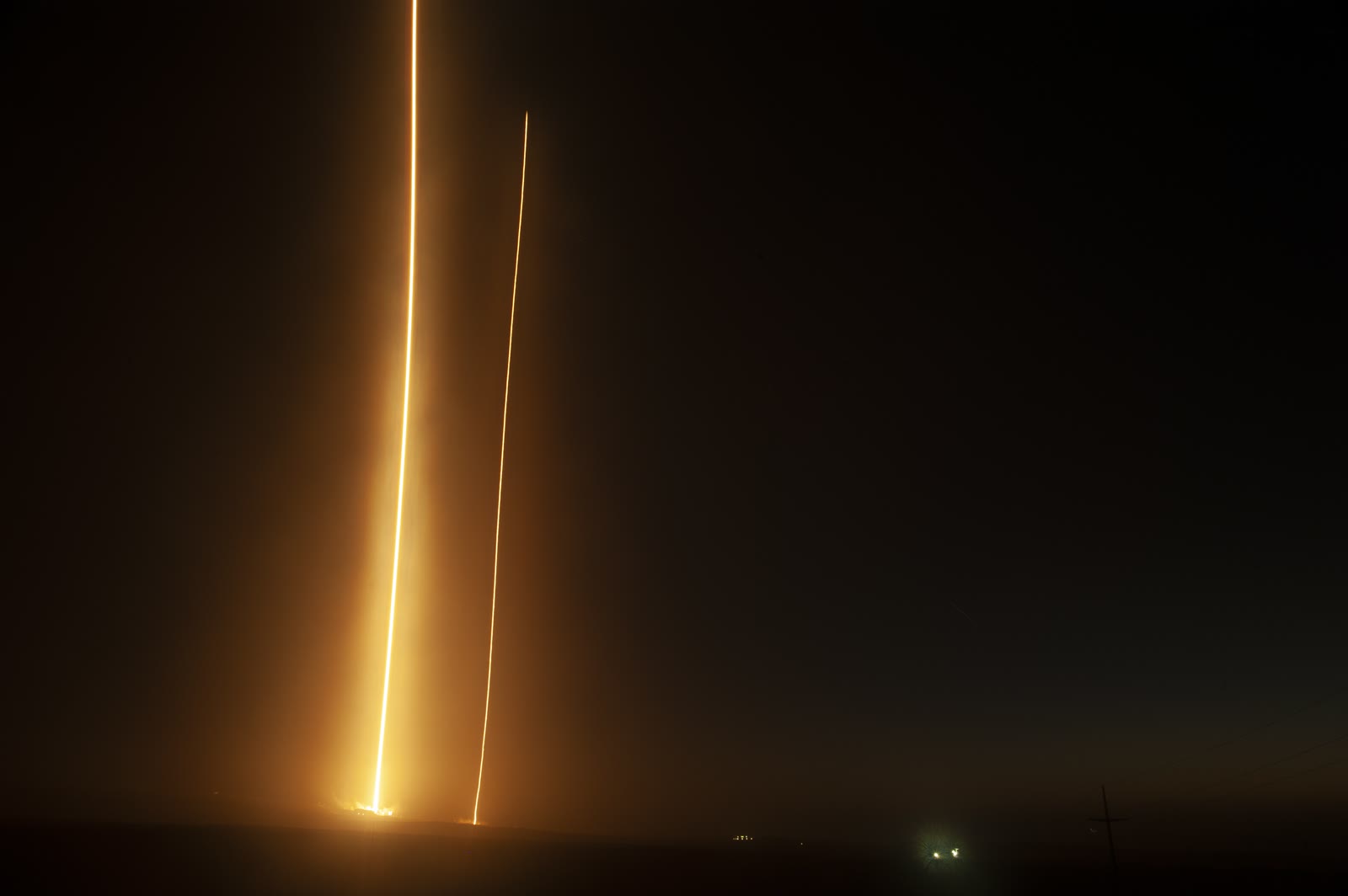
Specific Orbital Energy and Starship's First Closed Orbit
Essence: Orbit is not "high enough." It is sideways speed. At the altitude SpaceX published for Flight 14, about 275 km, a circular orbit needs 7.74 km/s. The insertion burn is the burn that closes the path so the ship no longer intersects the atmosphere.
First Principles Foundation
Newton's law of gravitation plus Newton's second law, for a vehicle whose mass is negligible next to Earth's, give a central acceleration
a = −μ / r²
pointed at Earth's center. μ is Earth's gravitational parameter, 3.986004418 × 10⁵ km³/s². r is the distance from Earth's center, not the height above the ground.
Mechanical energy per unit mass is conserved when only gravity does work:
ε = v² / 2 − μ / r
The shape of the path is fixed by ε and by angular momentum. For a bound ellipse the semi-major axis a satisfies
ε = −μ / (2a)
A circle is the ellipse whose semi-major axis equals r, so
ε_circle = −μ / (2r)
and the speed that belongs to that energy, from the energy equation with r = a, is
v_circle = √(μ / r)
If perigee — the lowest point — lies inside the sensible atmosphere, drag removes energy and the path is not a lasting orbit. "Suborbital" in that sense means the vacuum ellipse would intersect Earth or the atmosphere, so the vehicle returns without anyone commanding a deorbit.
Step-by-Step Derivation
-
Take Earth's volumetric mean radius as R = 6371 km. SpaceX's published Flight 14 altitude is approximately 275 km, so r = 6371 + 275 = 6646 km. "Approximately" matters: a few kilometers of altitude move the result by meters per second, not by a kilometer per second.
-
Circular speed at that radius:
v_circle = √(398600.4418 / 6646) = √59.976 = 7.744 km/s
About 7.74 km/s, or 27,880 km/h.
- Specific energy of that circle:
ε = −398600.4418 / (2 × 6646) = −30.0 km²/s²
- Period, from Kepler's third law for the same a = r:
T = 2π √(r³ / μ) = 5392 s = 89.9 min
- Bound versus return. Suppose the ship coasts to an apogee of 6646 km on an ellipse that would otherwise graze Earth's surface (perigee radius 6371 km). At that apogee the vis-viva speed is
v_a = √[ μ (2/r_a − 1/a) ]
with a = (6646 + 6371) / 2 = 6508.5 km, which gives v_a = 7.662 km/s. The burn that circularizes is
Δv = 7.744 − 7.662 = 0.082 km/s = 82 m/s
That 82 m/s is an upper-bound illustration for a trajectory that would hit the ground, not a measurement of Flight 14's burn. Any real suborbital coast whose perigee is already above the surface needs less. The point of the arithmetic is the scale: closing this orbit is a small burn next to the 7.7 km/s already gained in ascent.
- Assumptions. Two-body gravity, a spherical Earth of the stated radius, no drag and no thrust during the coast, and an insertion performed at apogee so the burn raises perigee rather than some other point. Oblateness, the remaining atmosphere at 275 km, and a burn that is not exactly at apogee all move the numbers. They do not change which quantity the burn is for.
Application to SpaceX / xAI
SpaceX's Flight 14 page states that the first thirteen integrated flights intentionally flew passively safe suborbital trajectories, and that Starship would light the insertion burn only after the flight-control team had confirmed enough redundancy to perform the later deorbit. That is the energy condition made operational. Once ε is the circular value and perigee is above the atmosphere, the ship stays up until a later burn or drag lowers perigee again. A missed insertion still falls back. A completed insertion does not.
On September 28, 2026, SpaceX posted that Starship would perform a burn with a single Raptor to enter an orbit of about 275 km, then that the insertion burn had put Starship into Earth orbit for the first time. The published timeline had allotted that burn about 19 seconds (T+25:17 to T+25:36). The flown duration was not restated in the posts. Reuters, PBS, and CBS, citing the official webcast, reported that one ascent engine had shut down early and that controllers still committed to insertion. SpaceX's own posts are the record that the burn happened and that orbit was the result.
The same flight then released 26 Starlink V3 satellites into that orbit. A satellite deployed from a closed orbit inherits a closed orbit. A satellite deployed from a suborbital arc inherits a suborbital arc. The insertion burn is what made the deployment an orbital delivery rather than a long lob.
Implications and Limits
The rocket equation spends almost all of its propellant reaching ~7.7 km/s. The last tens of meters per second decide whether the payload is in orbit. That is why a single engine, late in flight, is enough for insertion, and why losing one engine on the way up can still leave a path to orbit if the remaining engines and the deorbit path are healthy.
The limit is the one SpaceX wrote into the flight rules. A closed orbit is not passively safe. The energy that keeps the ship up is the energy a deorbit burn must take out. Flight 14's insertion was allowed because a way back down still existed. The companion lesson is that return burn.
The public record does not include Flight 14's measured insertion Δv, the exact orbital elements, or a post-flight statement that the 19-second plan was the burn that flew. The 7.74 km/s and 82 m/s figures are calculations from μ, a mean radius, and the published altitude, not telemetry.
Sources & Further Reading
- SpaceX, Starship Flight 14: spacex.com/launches/starship-flight-14 (published plan: first orbital insertion near 275 km; prior flights intentionally suborbital; insertion only with deorbit redundancy; timeline T+25:17 to T+25:36).
- @SpaceX, September 28, 2026: "Go for orbit" with a single Raptor into an ~275 km orbit; "Starship performs its orbital insertion burn and enters orbit of Earth for the first time"; payload deploy of all 26 Starlink V3 satellites.
- @elonmusk, September 28, 2026: "First orbital flight of Starship successful!"
- Reuters, PBS NewsHour, and CBS News, September 28, 2026, reporting the webcast account of an early engine shutdown and the subsequent decision to continue.
- Vis-viva and specific energy: standard two-body result. μ = 3.986004418 × 10⁵ km³/s² (EGM / IERS conventional value). Volumetric mean radius 6371 km.
Independent educational fan project. Not affiliated with Space Exploration Technologies Corp. (SpaceX) or xAI Corp. All content is for educational purposes. Sources cited where applicable.