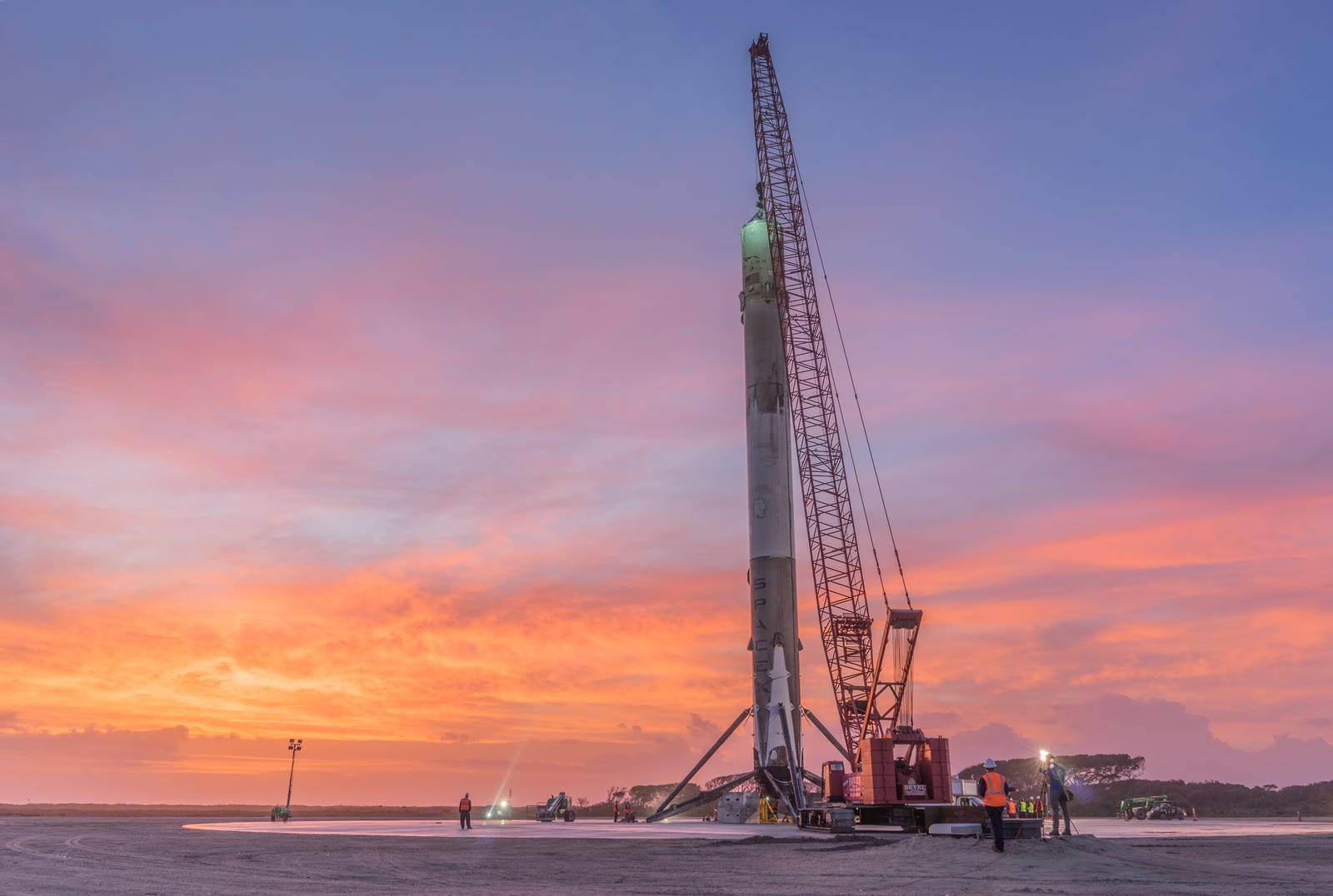
The Tsiolkovsky Rocket Equation and Falcon 9 Booster Reuse Economics
Essence: The Tsiolkovsky rocket equation reveals why recovering and reusing the Falcon 9 first stage produces order-of-magnitude gains in delivered payload per unit of propellant and cost.
First Principles Foundation
The fundamental truth is conservation of linear momentum in the absence of external forces (idealized in vacuum, no gravity or drag for the core relation).
The Tsiolkovsky rocket equation (derived in 1903) states:
Δv = v_e ⋅ ln(m₀ / m_f)
Where:
- Δv = change in velocity of the rocket
- v_e = effective exhaust velocity of the propellant (Isp × g₀)
- m₀ = initial total mass (structure + propellant + payload)
- m_f = final mass after propellant expenditure (structure + payload)
This is not an engineering heuristic. It is a direct mathematical consequence of momentum conservation applied to a system that ejects mass backward to propel the remaining mass forward.
Step-by-Step Derivation
-
Consider the rocket at instantaneous mass m, velocity v. In a small time dt it ejects dm (dm > 0) of propellant at relative velocity −v_e (backward).
-
Momentum before ejection (inertial frame): m · v
-
After ejection (no external force): (m − dm) · (v + dv) + dm · (v − v_e)
-
Expand, neglect second-order dm·dv term, simplify:
m · dv = v_e · dm
- Integrate from initial (m₀, v=0) to final (m_f, Δv):
∫ dv = v_e ∫_^ (dm / m) (note sign: dm negative for rocket)
Δv = −v_e · ln(m_f / m₀) = v_e · ln(m₀ / m_f)
- Interpretation: velocity gain depends only on exhaust speed and the mass ratio. Doubling the mass ratio adds a fixed Δv increment independent of size.
Assumptions (relaxed in practice): no gravity losses, no drag, constant v_e, no staging. Real trajectories add gravity and drag terms; the core leverage of mass ratio remains.
Application to SpaceX / xAI
Falcon 9 first stage (Merlin 1D) achieves high mass ratio on ascent. After MECO the booster performs boostback, entry, landing burns using remaining propellant.
Public data (approximate, representative):
- v_e (sea level Merlin) ≈ 2.8–3.0 km/s
- Typical propellant load allows significant Δv budget for recovery while still delivering payload to LEO.
Without recovery: the entire booster mass is "wasted" after one use.
With recovery + refurb:
- The structural mass (the expensive part) is reused.
- The equation shows that for the same propellant investment, you can deliver the payload AND return the stage if the mass ratio and v_e permit a recovery Δv "overhead" that is smaller than the performance margin.
SpaceX demonstrated this with >600 booster landings and dozens of reflights of single boosters (B1067 reached 35 flights). Each reflight multiplies the payload delivered per unit of manufactured booster mass.
The rocket equation makes reuse transformative because the exponential relationship (ln of mass ratio) means small improvements in dry mass or propellant load produce large leverage when the vehicle flies again and again.
Implications and Limits
- Economics: amortize booster over N flights → cost per kg drops roughly linearly with N (after fixed refurb).
- Design pressure: every kg saved on the booster or every second of Isp gained is multiplied by the number of reflights.
- Starship extends the same principle at 100× scale: full reusability + rapid turnaround is the only path the equation allows for the required tonnage to Mars.
Ignoring the equation (expendable designs) caps civilization's reach; embracing it (rapid reuse) opens the mass-ratio frontier.
Sources & Further Reading
- Tsiolkovsky, K. (1903). "Exploration of Cosmic Space by Means of Reaction Devices".
- Sutton, G. P. & Biblarz, O. Rocket Propulsion Elements (standard derivation and corrections).
- SpaceX official: Falcon 9 flights, booster reuse records, IFT-5 catch (2024-10-13), Starship V3 updates (spacex.com/launches, /updates).
- Public statements and telemetry summaries on booster recovery propellant budgets and reflights.
- Site context: reusability-revolution.mdx, first-principles-frontiers.mdx, starship-path.mdx.
Independent educational fan project. Not affiliated with Space Exploration Technologies Corp. (SpaceX) or xAI Corp. All content is for educational purposes. Sources cited where applicable.