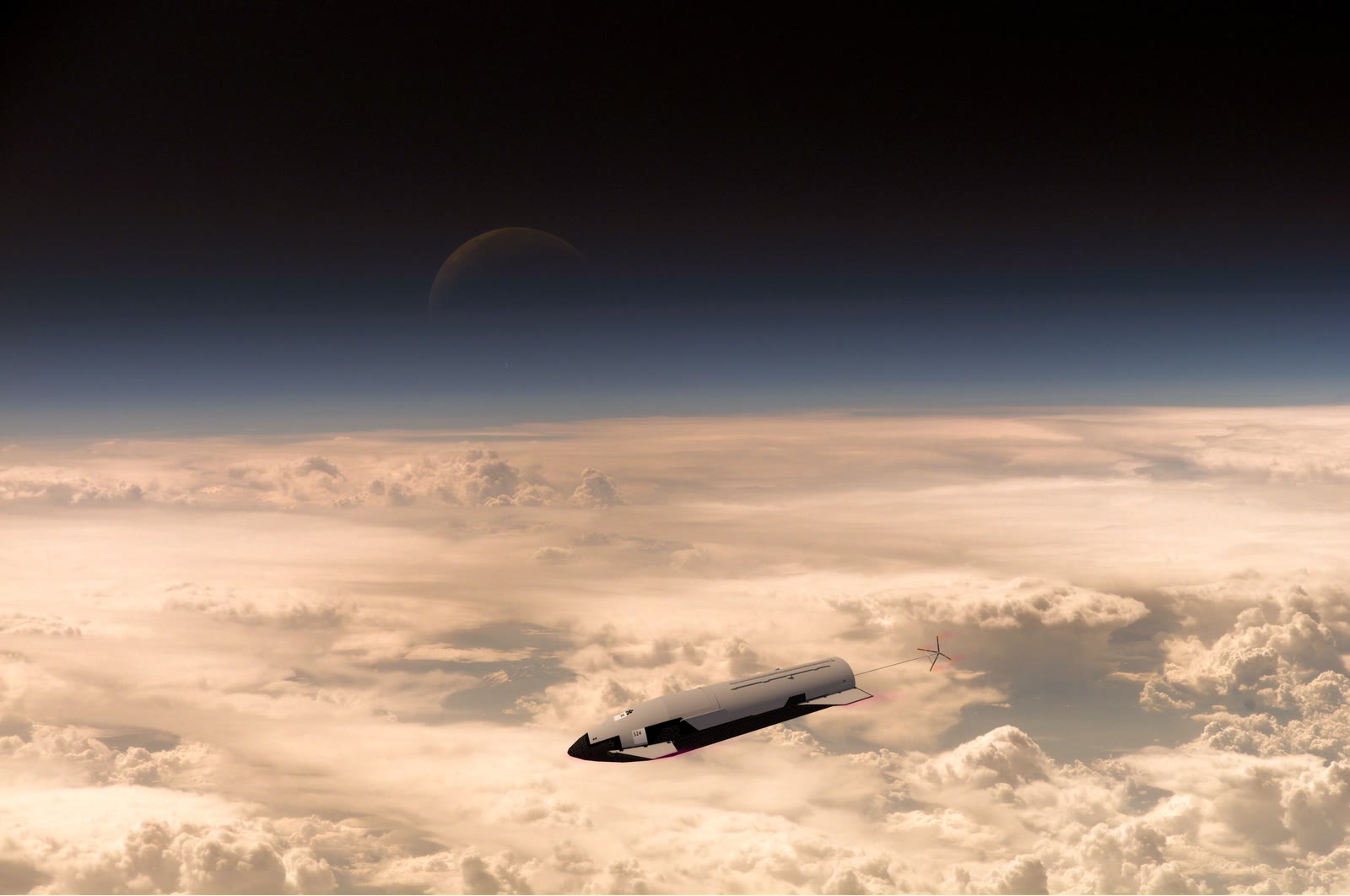
Stagnation Heat Flux and Convective Heat Transfer on Starship Reentry Heat Shield
Essence: Convective and radiative heat flux during atmospheric reentry scales with the cube of velocity and density; Starship's tiled heat shield manages this to enable full reusability after orbital and interplanetary returns.
First Principles Foundation
The governing physical laws are conservation of energy and the fluid dynamics of hypersonic flow. Stagnation-point convective heat transfer rate q_conv scales approximately as q ∝ ρ^ v^3 (from empirical correlations derived from boundary layer theory and energy balance), where ρ is freestream density and v is velocity. At orbital speeds, radiative flux from the shock layer adds significantly.
This derives from the kinetic energy of the vehicle being converted into thermal energy in the bow shock; the heat load must be rejected or absorbed without structural failure.
Step-by-Step Derivation
-
Vehicle kinetic energy per unit mass (1/2) v^2 at reentry velocity (~7-11 km/s for LEO/Mars return) must be dissipated as heat.
-
In the shock layer, post-shock temperature T2 ~ (γ-1) M^2 T1 / 2 (from Rankine-Hugoniot relations for strong shocks), leading to high convective transfer to the surface: q = h (T_aw - T_w) where h is heat transfer coefficient ~ sqrt(ρ v).
-
Integrated heat load Q = ∫ q dt over trajectory; peak q occurs at peak dynamic pressure.
-
For radiative component at high v, q_rad ~ σ T_shock^4 * emissivity factors, dominant above ~10 km/s.
-
Assumptions: equilibrium flow, no ablation initially; real tiles use low conductivity material and gap design to limit conduction. Starship iterates tile attachment and coating based on flight data.
Application to SpaceX / xAI
Starship upper stage reenters from orbital velocity after payload deploy or from lunar/Mars trajectories. The heat shield (thousands of hexagonal tiles) protects the vehicle structure during peak heating, as demonstrated in IFT flights with progressive improvements in tile performance and gap sealing. Success here is prerequisite for catch or landing and rapid reuse; without it, the vehicle is expendable on return.
Implications and Limits
The cubic velocity dependence means small increases in entry velocity (Mars direct return) dramatically raise peak flux, requiring thicker or more advanced materials. Limits include tile mass penalty reducing payload, attachment reliability under vibration and thermal cycling, and refurbishment time between flights. Starship's design trades mass for reusability at unprecedented scale.
Sources & Further Reading
- In-repo: project-docs/research/spacex-xai-deep-research.md (heat shield iterations, IFT-5 reentry data); content/articles/starship-path.mdx (tile performance, reentry from orbital velocity).
- Aerothermodynamics fundamentals from Sutton and hypersonic flow texts.
- SpaceX IFT updates detailing heat shield evolution.
NVIDIA stack referenced for CFD simulation of shock-layer heating and material response in trajectory design.
Independent educational fan project. Not affiliated with Space Exploration Technologies Corp. (SpaceX) or xAI Corp. All content is for educational purposes. Sources cited where applicable.